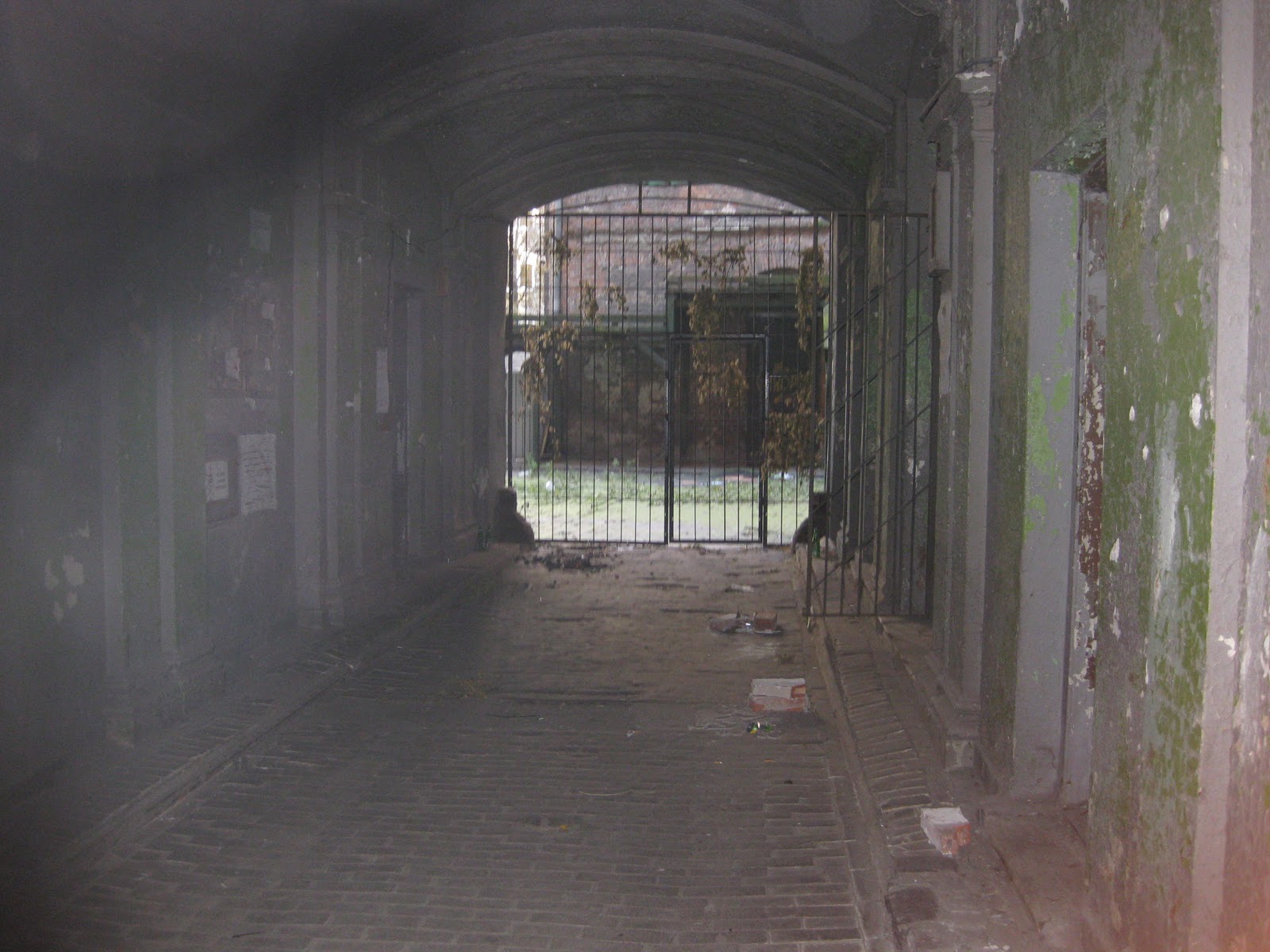
After checking in and taking quick showers, we met up with Michael Reiss, a friend-of-a-family-friend who was born in Łódź (and a grade-school classmate of famous architect Daniel Liebskind), grew up in Israel, and works in the Warsaw office of an Israeli company. He'd agreed to show us around the city for the day. First, we went to see some sites in the former Warsaw ghetto, most of which was destroyed during the Ghetto Uprising in 1943. We did see some courtyards and bomb-damaged buildings that partially survived, including a wall that's been incorporated into the facade of a new building.

 |
| this first of many shots of the back of my dad's head... |
 |
| seamless integration? |
 |
| the city cannot condemn this building, because there's an owner on record somewhere |
 |
| courtyard |
 |
| exterior wall (what's left of it, anyway) |
 |
| courtyard, old and new |
Next, we went to see some monuments commemorating the leaders of the Ghetto Uprising, including the remnants of the bunker where they held meetings, and where they committed suicide rather than allow themselves to be captured by the Nazis:
 |
| English |
 |
| Yiddish |
 |
| Polish and Yiddish |
 |
| bunker |
 |
| Leaders of the Ghetto Uprising | | | | |
|
|
Then, we saw the
Monument to the Warsaw Ghetto Heroes, and the construction site where the new
Museum of the Jews of Poland, just across the plaza from the monument:
 |
| Dad in front of monument |
 |
| this relief carving is on the back of the monument (facing the street) | |
|
 |
| Museum under construction |
 |
| Interior space |
Lastly, we headed down the remainder of the
Path of Remembrance to the
Umschlagplatz. During the war, there was a train station here where Jews and Roma were shipped off and sent to Treblinka. Now there's a open-roofed memorial there. The memorial site was crowded with bored-looking Israeli teens on holiday, which kind of diminished the emotional impact for me. It was also hard to get good photos of the site, but I did get some of the carvings on the main wall.
Michael then drove us to
Ulica Próżna ("ulica" means "street"), a little street at the other end of the Ghetto where a few old tenement buildings still stand. Apparently there are plans to renovate/restore them, and now there are some really cool photos of some of the former Jewish residents displayed outside. The street was very narrow, so it was difficult to capture the siting of the buildings, but here are some photos anyway:
 |
| peering into a courtyard |
 |
| we were not the only tourists/photogs... |
Next we drove to the rebuilt
Old Town/
Stare Miasto (this area was heavily damaged during WWII, and it was painstakingly rebuilt, in some cases using original bricks, to its former pre-war glory) and had lunch at
Pod Samsonem, a "Jewish-style" restaurant owned by gentiles. It was packed at lunchtime, which I suppose is a good sign. Our food was very good. After lunch we strolled around for a bit, including a walk through
Market Square (
Rynek Starego Miasta), a lovely plaza featuring the famous Mermaid statue. We then drove back downtown for coffee (excellent) and pastries (delicious) at Cafe Blickle, a Viennese-style cafe on Ulica Nowy Świat (New World Street), which has been owned by the same family since the 1860s.
 |
| entering Old Town |
 |
| Lunch! |
 |
| evocative street-scape |
 |
| Dad's head, Rynek |
 |
| mermaid |
 |
| Me & the mermaid |
 |
| water pump |
 |
| alleyway |
 |
| architectural details |
 |
| the blue building on the left is awesome |
After driving around for a bit, past Embassy Row and the
Parliament building, Michael dropped us off at the hotel. We had a nightcap at the hotel's
bar and headed off to bed. We we so glad to have met yup with him. He was so personable and was a great storyteller with a lot of knowledge about Warsaw's past and present. Without him, we would not have been able to experience so much in one day. What a fantastic day in a beautiful, thriving, and livable city. It's impossible to see all of
Warsaw in the short time we had here, so I guess I'll just have to come back...